Tuesday, July 14, 2009

How to Navigate Seoul's Metro System


I might as well have been looking at the control panel for a NASA space shuttle when I stared down a subway kiosk on the outskirts of Washington D.C.

It didn't take much to confuse me at this point. On Wednesday, a 13-hour flight had brought me home from South Korea. On Thursday, we packed up and left Atlanta for D.C. During the all-night drive, my jet lag was an advantage: The 2 a.m. to 7 a.m. shift? No problem.

But now it was Friday. Sleep-deprivation had caught up with me. And if the fatigue wasn't enough to muddle my brain, the puzzle of buttons, fare charts, digital instructions, money receptacles and receipt dispensers on the D.C. metro kiosk finished the job.

I wasn't the only one struggling. At 10 a.m., travelers were already pouring into town for Fourth of July celebrations. Everyone who arrived at the Greenbelt station needed instructions, and they looked haplessly to a lone attendant who, judging by his palpably annoyed state, had spent his entire morning dealing with ignorant tourists.

In the end, I left with two tickets in hand, one each for my wife and me, but the process wasn't easy. First I had to find the reduced holiday rate on the chart above the kiosk. Then I had to select a pass or single fare card. Next I had to choose the quantity of fare cards and the value of each. The machine's configuration was mind-numbing. With no automation, I had to add up the total fare in my head. And there were no numbered buttons. The fare simply started at $20.00, and I had to use what looked like a white plastic light switch to toggle all the way down to $4.70.

At this point, I really began to miss South Korea.

Compared to D.C.'s, the metro system in Seoul is a breath of fresh air. English is available at all kiosks, most of which have bright, intuitive touchscreens that make the ticket-buying process quite simple. In Korea, I could recheck the destination on my map, write down some notes, buy the ticket, retrieve my change and head to the turnstile faster than I could figure out how to simply work the machine in Washington.

Of course, your ability to navigate any subway will be directly related to prior experience. If you've never negotiated the pulsating, bullish crowds, the labyrinthine tunnels, the oft-confounding ticketing systems, your first time will likely be more of a crash course than a joyride. I've ridden subways in Hong Kong, Paris, Shanghai, D.C. and Atlanta, and the experience undoubtedly helped me in Seoul.

With more preparation, Korea would've been even easier, so I'm offering a few words of advice for those who might be planning a trip. I'm no expert, so more experienced folks, please feel free to correct or augment what follows.

Getting on

Seoul proper has nearly 11 million people, and the city claims that about half South Korea's population - more than 24 million - live in or commute to its metro area. Those numbers prove that the moving around this city will mean trial by fire for the first-time subway rider.

It sounds simple, but I've found that half the battle is knowing where you're going and being prepared. I recommend grabbing a metro map at the airport and studying the 10 lines during the hour-long bus ride into Seoul from the airport in Incheon. That way you'll at least have an idea how to hit the ground running upon arriving at the hotel. I really don't have any tips on how to best read a subway map. It's mostly just instinct, experience and most importantly, attention to detail.

Find the nearest subway station to your hotel. Any will do, but if you're at a confluence of different lines, consulting a map first could help you pick a line with a quicker route to your final stop.

With your destination in mind, stroll up to the kiosk. If you're an English speaker, you'll have no problem seeing the ENG button at the bottom of the screen, a stark sight in a sea of Korean. I'm assuming if you're reading this you're an English speaker, but just note that Korean and English are the only two languages offered at the kiosks. I saw some Japanese girls and a Chinese couple having to use English to select their destination on the digital screen, although the paper map I got from the airport listed stops in Chinese and Japanese.

After you select English, you'll have to choose what type of fare you want. I chose "single journey" every time, although if I were staying longer I could've loaded up a T-money card. Even buying single fares, the metro is considerably cheaper than in most American cities. It cost me just a little more than a dollar for a one-way fare that allowed me to traverse the city.

Once you've tapped a ticket type, many of the most popular stops will flash up on the screen. If yours doesn't appear, click the letter(s) the stop's name begins with, and an alphabetical list will come up. You're not bound to this particular stop if you change your mind during the ride. The machine just uses your stop to calculate your fare. If you disembark at a different destination, make a visit to the clearly labeled "fare adjustment machine" to pay what you owe or get your change, whatever the case may be.

Note also that your fare will include a 500-won deposit to cover the cost of the orange metro card in case you don't return it. After you get off, make sure to take your card to the "Deposit Refund Device." Slide it into the slot, and take the 500-won coin that drops down into the coin return. While 500 won doesn't seem like much - it's less than USD $0.50 - the cost adds up after double-digit subway rides. Get in the habit of getting your deposit back, and it won't be a problem.

Finding Direction

After scanning your newly acquired orange fare card and passing through the turnstile, the next order of business is to figure out which way to go. This is crunch time. Deciding which train will mean the difference between being late or on time. It's tough at first, because the Seoul metro maps and signs don't give you cardinal directions like east or west. They list a smattering of stops pointed toward each of the lines moving in opposite directions.

I devised a sort of scheme to deal with this. The ideal situation is to see your stop on the sign, but that won't happen if you're transferring down the line or getting off at a lesser-known stop. This is another reason it's important to have a map handy. You'll have to match the unfamiliar words on the sign with the unfamiliar words on the map to see which ones correlate with the direction of your final stop. This is one of the toughest parts of navigating the metro, as the choice between one direction and another often must be made in a split second with people rushing, tones blaring and doors sliding shut. Not to mention that the names on the signs, though transliterated, can sometimes begin to look and sound the same to foreign eyes and ears.

And now to my non-foolproof system: I quickly check my destination on my map and scan for the next and last stops in that direction. I also look for any potential landmarks in between. Stadiums, shopping districts, universities and tourist sites all generally make the cut.

The Ride

So you're through the sliding doors, out of the stifling heat that hangs in the subway corridors and into the quiet, air-conditioned comfort of the train. And hopefully you've picked the train moving in the right direction.

Now what? If it's not crowded, slide into a seat, but be sure not to take one of those designated for the elderly.

Once you're seated, the ride is pretty easy. Just don't expect many people to talk to you. I had a few benevolent souls speak to me, but mostly I just kept to myself. Others will be doing the same. For the most part, everyone will be engrossed in whatever content their cell phone is feeding them at the time: TV, texting, conversation, Web surfing. It's all on the table. And the people who aren't engaging in one of those activities are holding the phone in their hand, poised to pounce at the next chance for conversation.

Memorize your stop and its corresponding number, and you can chill a little, especially if it's a long way away. Announcements in English and Korean, along with a festive little recorded song, warn passengers as each stop approaches. It's smooth sailing from here, but keep checking the maps as you pass each stop. Leaving mental breadcrumbs will help build a map in your head that will make this process easy to replicate on the way back.

Getting out

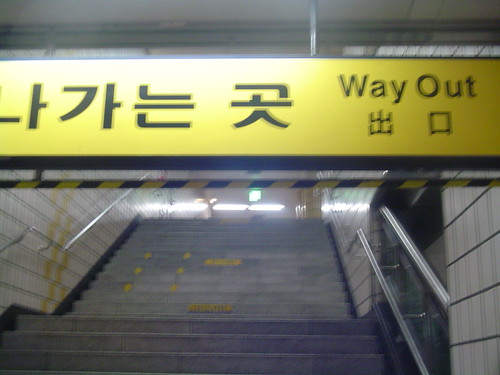
Getting out of the subway isn't hard. Mostly you just follow the signs that say "Way Out" in English.

But picking the right way can be tricky. Subway stops often double as underground crosswalks. Exits are numbered, and each one will usually spit you out on one of the four corners created by intersection. The key again is to know ahead of time which way you need to walk once you get above ground. If you know that as well as the appropriate road to follow, convenient maps on the wall will help you find your way.

Other issues:

1. Dealing with crowds - Like most Asian countries, the violent crime rate in Korea is pretty low. But just because you likely won't get mugged, don't assume that you won't get robbed. Without being paranoid, be aware that valuables are called such for a reason. Take care of them. Keep bags in front of you, and watch out when the crowds really begin to press in.

2. Entertainment - There are actually lots of things to do on the subway if you're creative. My favorite? Watch people. Also you can watch TV on the phone of the person sitting next to you. Read or take notes. Study your map. Notice the personalities of the different subway stops. Count the number of people talking on cell phones.

There's always the occasional alms-seeking entertainer, too. At one stop, I saw a South American guy playing an assortment of flutes from the Andes and selling his CDs. On one train, a blind man walked through with an outstretched hand, playing "Take it to the Lord in Prayer" on a harmonica.

3. More Resources - This isn't the definitive guide. The Korea Tourism Web site has some great information that I haven't covered. More resources are linked below:

-Apps with maps - Seoul metro on your iPhone or iPod touch
-Interactive map with all major Korean cities' metro lines
-Click the Seoul metro map above to see a full-size version

Video of Andean flute player:


Anybody out there got any words of wisdom, disagreements to add?

Sunday, July 12, 2009

Uighur Watching


The world's spotlight is now on China's wild northwest, where ethnic tensions came to a head last week in a conflict that left nearly 200 dead and thousands injured in the city of Urumqi, the capital of Xinjiang province.

The tragic events have given me some clarity. While backpacking through the region in summer 2006, I was detained and interrogated five different times by police. With another example of the region's volatility, I have a little bit better idea why.

Xinjiang is the ancestral homeland of nearly 10 million Uighurs, Turkic-speaking Muslims who make up about half of the region's population. Although the province is officially known as the Xinjiang Uighur Autonomous Region, the minority Uighurs have expressed resentment over increasing Han encroachment on what they see as their territory, known as East Turkestan to those bold enough to promote the region's autonomy.

The Han Chinese have been migrating into Xinjiang over the last several years to seize opportunities in the resource-rich region. The central government has enacted policies and programs encouraging this westward expansion, some say in an effort to dilute Uighur influence and exert more control over the region. The Han are China's largest ethnic group, making up about 90 percent of the country's population. Uighurs have complained that the benefits of economic development in the province - which makes up about a sixth of China's landmass - haven't been fairly shared.

China has had more than a few reminders that Xinjiang is a stick of dynamite waiting to be lit. Last year, two of Uighur assailants ambushed a Chinese police unit in the border town of Kashgar, killing 16 a month before the Beijing Olympic Games. (News reports called into question the validity of the official account)

Last week's spark occurred when a group of Uighurs - some put the number at nearly 1,000 - gathered to express dissatisfaction for Chinese government inaction in the killing of two Uighur workers by Han Chinese during a brawl at a factory in faraway Guangdong province. The Urumqi protests grew violent when Chinese police tried to disperse the crowd.

After the Uighurs ran wild, thousands of Han sought revenge and took to the streets with sticks, knives and other implements. When the dust settled, more than 180 people were dead, most of them Han, according to Chinese government propaganda. Uighur activists claim that hundreds of Uighurs were shot and killed during the police backlash. The Chinese government has not confirmed that, nor will it. The latest figures put the number arrested for their roles in the riots at 1,400, and some are reporting that Uighur men are being rooted from their homes.

The Chinese government would like nothing more than to pin this on "separatist" elements. In fact, foreign ministry spokesman Qin Gang has already blamed Rebiya Kadeer, the world's foremost Uighur activist, for fomenting the unrest. Last year, during the assault on the Chinese police patrol, the government played the "terrorist" card, saying that those who committed the acts must've been Islamic extremists.

Perhaps because of their Islamic beliefs and relative obscurity, the Uighurs' cause has not been celebrated as heartily as that of Tibetans and other oppressed peoples. The Chinese government says that it gives Uighurs ample opportunities. Uighurs feel disenfranchised. I have to say that if not for my experiences in Xinjiang, I might be tempted to believe the Xinhua (Chinese state media) version of events.

But this conflict runs pretty deep, and it has a political root, as most so-called "ethnic" conflicts do. The Qing dynasty conquered Xinjiang in the 1870s, and since then the Uighurs have mounted a variety of struggles - bombings, shootings, rebellions and demonstrations - to shirk Chinese rule. In the 1940s, they succeeded for five short years, when the East Turkestan Republic blossomed as the Communist and Nationalist forces were battling for control of the mainland. When Mao Ze Dong came to power in 1949, he sent the People's Liberation Army to bring the western provinces back under Chinese control. The Uighurs submitted without a fight.

The Chinese government issued a report in 2002 blaming Uighurs for 200 separate terrorist incidents during the first few years of 21st century. The claim was made the year after 9/11, when President Bush laid down America's "for-us-or-against-us" gauntlet with regard to the fight against terrorism. China quickly sided with the U.S., stating its commitment to quelling terrorist activities within its borders. But some think that China’s claim of allegiance to the U.S.-led war against terror is a façade meant to legitimize the brutal suppression of anti-Chinese sentiments in Xinjiang. When Uighur prisoners got out of the Guantanamo Bay prison facilities last month, the U.S. would not repatriate them to China for fear they would be killed or harassed. Instead, the small Pacific island nation of Palau and the Atlantic island of Bermuda took the Uighurs in, with much backlash from their populations.

The bottom line in all this is that the Chinese government wants economic control of the northwest. The Uighurs want more autonomy, less encroachment. It's sad to say, but despite the best efforts for cultural understanding on both sides, these ideologies clash and will inevitably result in friction in the future, much like the tumultuous 20th century. Let's just hope subsequent struggles won't be as fierce as last week's.

More resources:

My recent article on Coke's new bottling plant in Xinjiang

See also: A View of Pre-Olympic Tensions in Xinjiang

Monday, June 08, 2009

Daily Bread Deja Vu

A third short story from one of my Asia mission trips has been posted on the International Mission Board's East Asia field blog.

It's been three years since I went on a mission trip in that part of the world, but God has kept the memories fresh. I hope to continue putting down on paper (or blogs, as the case may be) all the amazing experiences He's allowed me to have.

Click here to check out the story about meeting a friendly face while walking through a rainforest park in southern China.

This post will link you to the other two stories the East Asia blog has published, as well as a chronological list of entries from my 2006 trip.

Sunday, June 07, 2009

Lessons from the First Swedish Woman to Climb Everest

It's a rare privilege to talk to some who's summited Everest, rarer still to meet someone that has some superlative attached to their feats on the mountain.

Renata Chlumska, a renowned 36-year-old Swedish adventurer, became the first woman from her country ever to reach the roof of the world in 1999. She was slated to come speak in Georgia two weeks after my Sweden trip, and I was going to interview her in Malmo.

She was headed to Hungary the next day and couldn't make it to meet me, so we spoke by phone instead.

Though Everest is her claim to fame, I found out that her speech was actually going to cover her Around America Adventure in 2005-06, when she kayaked and biked around the perimeter of the lower 48 states. This year is the 10th anniversary of her initial Everest summit, and it's now "old news," she joked.

Adventurers have to tout their accomplishments. It's how they make their living, whether they're motivational speakers whose value is in their unique perspective or expedition leaders who need to brand themselves as trusted guides for extreme outdoor trips. (Chlumska is both.)

What struck me as I talked to her is how she believes that challenges on the mountain are similar to those we face in life, without the blistering cold, physical exhaustion, struggle for oxygen and altitude sickness, of course.

"For me, being tired, going through hardship, when it's painful, your body hurts and you're drained mentally and physically, that's not the reason to turn back. That's just part of the challenge," she told me.

That was so refreshing for my American ears to hear. Our culture worships comfort and ease and values convenience, not discipline.

For Chlumska, overcoming hardship - valuing the destination over the discomfort in getting there - is part of gaining a new perspective that sets you above the crowd.

"You just get a different view when you climb a mountain or hill or tree," she said. " You just get to see a different angle."

It's the same way in faith.

If anyone would come after me, he must deny himself and take up his cross daily and follow me. -Jesus, Luke 9:23.

Saturday, June 06, 2009

A Southerner in South Sweden

I know I keep saying this, but for someone whose international travel experience is mainly in China, it's really easy to become mesmerized by Europe. That sounds almost counter intuitive, because some would argue that the culture in Europe is so similar to the U.S.

Here's what I mean, though. China's a vast country, almost a continent in its own right, just like the United States. I've traversed it from east to west, examining all kinds of cultures in interior provinces and border regions. But no matter how exotic the locale or how many miles I travel, I'm always in the same country.

Contrast that with Europe, where nations rub elbows with each other. Especially with the EU's paper-thin borders, you can cross with hardly any indication that you've left one country and entered another.

That was my feeling when my Sweden-bound train crossed the Oresund, the strait that separates Sweden and Denmark. Since a bridge linked the two sides about a decade ago, the southern region of Sweden, called Skane, has become tied to Copenhagen's metropolitan area. It makes sense economically, considering the fact that Stockholm is six or seven hours away by train or car.

A Day in Malmo

My first stop was the capital of Skane, a city called Malmo. It has a quarter-million people and lies right on the Oresund. My host, whom I had just contacted on Skype that Sunday morning, would meet me at the Malmo South station. From Copenhagen's center, it was only 15-20 minutes away.

Nils Eric Svensson, an economic development official with quite possibly the most Scandinavian name ever, stood with the hint of a smile on his face as I disembarked. A tall man with piercing blue eyes and some of the biggest hands you've ever seen, I had met him at our office in Georgia over a year ago. We didn't realize it until we finally saw each other. He helped me stuff my bags into his Volvo wagon, which along with the Saab wagon could compete for the title of Sweden's flagship vehicle.

He took me on a driving tour of Malmo. If Nils could be believed, the city was being transformed by an emphasis on the knowledge economy, logistics and environmental technologies. We passed a huge new IKEA facility, a new subway tunnel under construction and a 50,000-seat sports arena on our way to downtown.

As we drove, Nils gave me an abridged look at Malmo's nearly 1,000-year history. The city was established in the 1100s, when what is now southern Sweden was a part of the Danish kingdom. Malmo was originally called "Elbow" because of the shape of the nearby harbor. It has a long maritime history that led to its ascension as a shipbuilding center with a thriving wharf industry earlier in the 20th century. When the construction of ships moved largely to places like South Korea, some of Malmo's large wharfs closed down, leaving thousands jobless and the city with an identity crisis. For Malmo, it was a fork in the road, and from the tale that Nils was spinning, the city chose the right direction. "I've been working in and close to this area for all my time, but I have never experienced a development like we have now," he said.

Many of the wharf buildings, steel factories and old buildings now house companies that make devices for steering ships, clean technology applications, animation for mobile phones and other products that represent an about-face from the city's industrial history. As if to cap the transition, in 2001 construction began on the Turning Torso, a lonely 55-story skyscraper with a unique twisting design. It towers over the harbor and the shorter buildings around it. The Torso replaced the huge Kockums crane that stood as the city's iconic structure in the harbor during the wharf days. On a clear day Nils said it could be seen from 100 kilometers away. Along with the jobs, it too was shipped to South Korea in 2002, symbolizing a clean break with the past.

Where Are They Hiding?

If Malmo had 250,000 people, I wondered where they were hiding. It was a cool, overcast, blustery Sunday, so I assumed many people might be at church or staying indoors. The city was quiet with no semblance of hustle or bustle. Over lunch, Nils said the lack of activity had more to do with the season than religious fervor. In a land dotted with centuries-old churches and universities, not many people make a weekly habit of attending services, he said. It was the beginning of April, and everyone was waiting for the weather to fully change. Then they'd be out in force, walking along the water and taking advantage of the shift from harsh winter to temperate spring.

After lunch in Malmo, Nils drove me up to Lund, an old town with a huge university with a strong research sector that has attracted many high-tech companies. On the way, the green landscape impressed me. We were close to a relatively large city, but the four-lane highway still felt remote. Unlike in America, Sweden doesn't allow billboards to dot every piece of pasture land along the side of the road. We occasionally passed giant, white wind turbines.

Nils said that Malmo residents joke that their Danish friends on the other side of the Oresund strait never get any sunsets because they're facing east. After lunch, Nils and I had about five more hours until darkness fell. I didn't want to take too much of his time, so we went to his downtown office to conduct a video interview I'd put on my company's Web site.

I was talking to him about his region's plans for the upcoming Swedish Entrepreneurial Days conference in Savannah. Tragically, two weeks later, Nils was killed when a truck hit him while he was crossing a street in Savannah. The day before his death, Nils told me at the conference that he was enjoying a sort of vacation in Georgia's oldest city. It was his fifth visit. There was no way of knowing that my interview with him in Malmo would be his last media appearance.

I left Malmo with a deep respect for Nils, enriched by his Swedish brand of Southern Hospitality. With no real benefit for himself, he had taken three hours out of his day off to show a nosey reporter around his city. For me, he turned what could've been a wasted day into an opportunity.

On to Vaxjo

Nils dropped me off a Malmo's train station, a beautiful old brick building that looked and felt similar to the one in Copenhagen. An army of bicycles were parked outside, and gulls fluttered around the structure, which stood in stark red contrast to the bright blue sky. Nils told me Danish architecture had inspired many of the structures in Malmo, and the town hall proved him right. It was situated on a square and looked like a smaller model of the one in Copenhagen.

It only took about 20 minutes for my train to arrive. I boarded and sat down facing east, the direction I would ride for two hours before reaching my next destination.

Vaxjo has branded itself as the "greenest city in Europe." The city takes pride in its quest to totally eliminate CO2 emissions, an effort it began in the mid-1990s. At least according to government leaders, its environmental focus really started long before that, when city officials decided in the late 1960s to clean up its polluted lakes.

While Vaxjo has failed to meet its ambitious CO2 reduction goals, it has reduced emissions by more than 30 percent since the early 1990s. The key to that has been the use of renewable energy sources to provide more than 90 percent of the heating energy. Like Georgia, Sweden has a wealth of forestry resources that it's trying to monetize further as nations form new policies toward green energy.

If you like nightlife, Vaxjo is probably not your place. Maybe it's just Sundays, but when I stepped out of my hotel at 9 p.m., there were very few downtown establishments open. I tried to resist being a fat American, but the choices for dinner were limited to a McDonald's and a questionable pizza place. I went with the tried-and-true golden arches and then retired to the hotel.

The next day was a flash of green. A Vaxjo university professor picked me up at the hotel and drove me around for awhile, showing me the advances the city has made in building environmentally friendly apartments and houses made almost entirely from timber that boasts elevated insulation capabilities that reduce the need for heating in winter.

We then went to the school and did video interviews about possible collaboration between Vaxjo University and the Savannah College of Art & Design. A publisher of an environmental magazine came in to talk to me about partnering with our international business news Web site. I then visited a company that makes kits to transform gas-powered cars into flex-fuel vehicles. Finally, I went to city hall, where Vaxjo's executive mayor laid out reason that his city has become so green-conscious: To create jobs, boost quality of life, and help Vaxjo make its name known on the international stage.

Vaxjo is more than just green energy, though. There'll soon be a glass museum showing off the city's history as a glass/crystal capital. There are great shops, a museum dedicated to the Swedish mass migration to America, and of course, some old churches and buildings. Not to mention that I was now in Smaland, the birthplace of Ingvar Kamprad's IKEA, the furniture giant that has swept the world.

I ate a quick dinner and headed back to the train station. My two-day whirlwind tour of southern Sweden was over almost as soon as it had begun. It was two hours back to the Danish capital. I grabbed a scarce room at a hotel near the Copenhagen central station. My first European tour ended the next day.