Monday, November 20, 2006

Rain for us, Rainforest

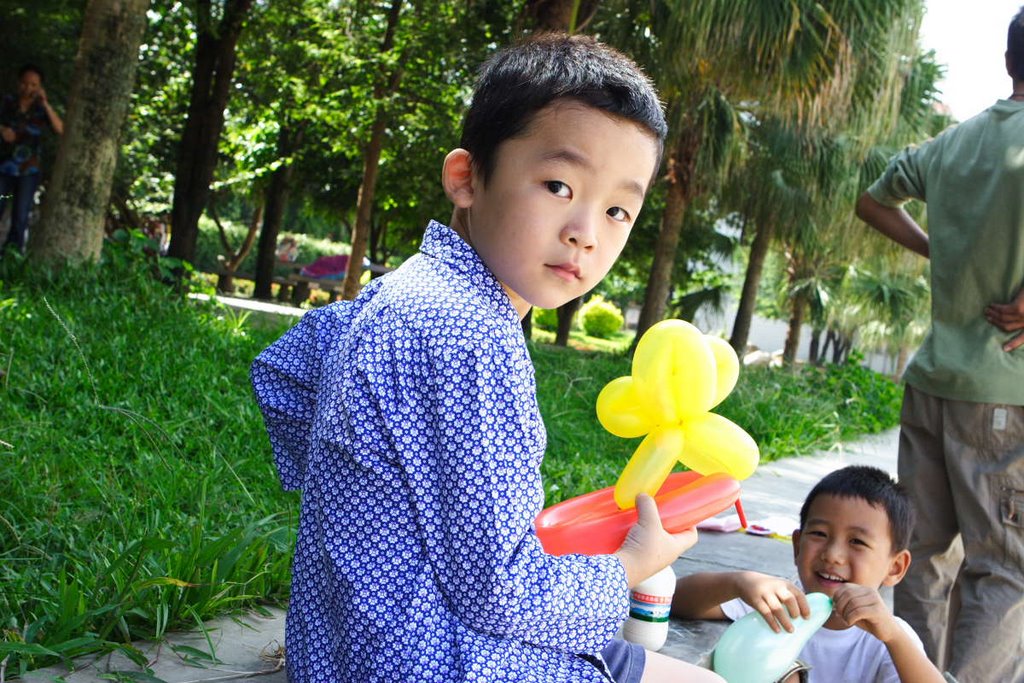
A kid plays with balloon animals at camp
When the balloon wars ended, our day had just begun. Leaving drenched, smiling kids behind, we boarded the bus. Our clothes had dried a little in the sun, but we still had to try our best not to soak the seats. For China, this bus was top of the line, and the school was very generous to taxi us around in it. The last thing we wanted to do was mess something up.

For lunch we headed to an outdoor restaurant specializing in food indigenous to our target people group. Not only is the food prepared in their style, but the restaurant also resembles one of their villages. A few free-standing huts surround the big hut at the center of the complex. Each small hut is outfitted with at least two round tables perfect for family dining.

Sweet pork ribs anchored the meal, which consisted of a diverse but balanced mix of dishes, both fiery and dull. The fish were fresh, probably having been snatched from the stream that morning. Even after going through the fire, they still puckered their lips at us. A bitter green herb soup, peanuts and vegetable succotash rounded out the meal. The most interesting thing on the menu this time, though, was the mysterious cornmeal fritter. As its name suggests, the sweet treat is a sticky cornmeal patty, breaded and deep-fried, and served opposite noodles and the spicy sauce I liked to call "death salsa."

Bellies full, we took the bus to our next activity: trekking. As I've mentioned before, JH sits in a verdant valley, and the surrounding mountain wilderness is littered with natural beauty and ecological diversity. To cash in on tourists that enjoy the outdoors, the government has constructed a rain forest park about 20 minutes (by bus) east of the city. The park allows visitors an up-close encounter with this province's humid climate and hilly terrain without the hassle of tents, machetes and gallons of bug repellent.

The park is divided into three basic levels: bottom, middle, top. The bus dropped us off at the bottom level, so we went to the relatively nice bathroom complex while the adults bought our tickets. Fanny pack strapped on and tickets in hand, Frank came to get us from the tourist activity center, where we had struck up a jam session on the huge Buddhist drums. (Drums were basically the only activity there.)

We walked on the paved trail that promised to lead us up to the third level, where the rain forest would actually begin. Golf-cart tram drivers offered to take us up the the modest incline for 15 kuai (each way). The offer enticed the lazy part of me, but the adventurer and glutton within me conspired to make this solution: I'd expend some calories and keep my 30 kuai to replenish them once we got back to the city (shaved ice, anyone?).

We passed a peacock pen and a beautiful pond where Chinese tourists had gathered to enjoy the weather. This was the first day without rain all week. I guess for purposes of clarity, this should be called level 1.5.

When we heard singing we knew we had reached level two. Large crowds had piled into a small amphitheater, which sat within splashing distance of a tall, man-made waterfall. The man on stage wore traditional garb and wailed something into his headset microphone, which was turned up way too loud. He entered into a rhythmic chant and his arms flailed wildly as he lit into the huge drums surrounding him. The crowd loved it.

Across the street (and back a little) from the theater sat an "authentic" minority village that had two points of entry: a long bridge from the main road, or a zip-line across a wide ravine. The bridge was free. The zip-line was 15 kuai (almost two U.S. dollars) each way. We left level two just as a flock of vibrantly dressed women got off a golf-cart tram. I guessed they were up next to perform.

If the image of the tourist trap hasn't solidified yet, it will with level three. To get to the staircase that led to the rainforest trail, we had to walk through trinket shops and a small cafe. The more experienced travelers told the greener ones to obey the Six Flags principle: Everything costs exponentially more at theme parks. And for China, this was a theme park.

Before the rainforest trail began, we found some of the best (or should I say worst) English translations I'd ever seen in China. My personal favorites: "Enter into monkeys, please safekeeping your stuff" and the "tropical rare and extinct plants park."
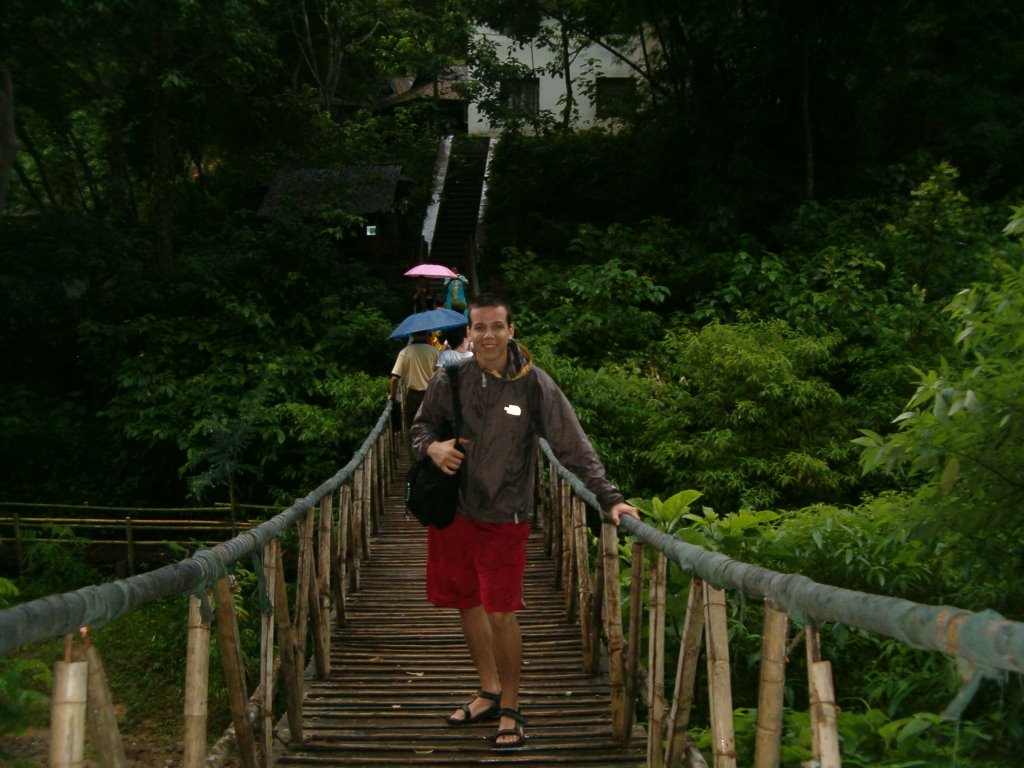
I stand on the bridge, careful not to sway
We crossed over a bamboo bridge reminiscent of an Indiana Jones movie, disobeying the sign that said in English, "No swaying." The trail, a flexible but sturdy path of interwoven bamboo, snaked upward along the sides of the small valley. Along the easy two-hour hike, vendors had set up kiosks (small huts) in another attempt to get into tourists' wallets. You could do anything here from archery practice to taking your picture with a giant python. Almost every kiosk was equipped with a computer and a printer, so the attendants could print your picture on the spot. It seems like digital cameras would've made this occupation obsolete, but these guys aren't dragging electrical cords through a wet forest for no reason. There must be bucks involved.

Halfway through the hike, the rainforest started living up to its name. Fat droplets crawled down the leaves of the canopy above and began to plop on top of our heads. Frank covered his camera with a plastic bag. Abby slipped and fell. The rest of us just picked up our pace a little bit. By the end, the trail had looped back to its beginning. Katy and I stopped to take a picture with the ostrich. Yes, the ostrich. He made his money as a steed, so we didn't even have to pay for the photo-op.

After stopping for some coffee at the tourist trap cafe, we headed back to level one. The downhill trek was a lot easier, despite the rain, which luckily had lightened up a little. Apparently, though, there had been some miscommunication. Our driver had left, and he would not be coming back. After standing in the rain for about 20 minutes, half of our team found taxis. The rest of us flagged a bus and hitchhiked our way back to the city. For a moment there, it felt a little like last year's journey, and I was just fine with that.

Tuesday, November 14, 2006

Recreation

We woke up at our normal time (a little before 8 a.m.) so we could leave the hotel by 8:30 in order to reach the school a little before 9. We had no class today, but we'd planned a 3-hour recreation period for the kids during which we'd learn a little English and have a lot of fun.

Brad and I volunteered for the basketball station, the one out of the nine field day-type competitions that seemed most appealing to us. True to form, neither one of us planned a format to handle the 20 kids that came to us as each class rotated between stations. So we made it up as we went along, tailoring our activity to the athleticism of each group.

It went surprisingly well. We did lay-up drills, shooting competitions and the three-man weave of all things (if you don't know what this is, I assume you never played organized basketball). With my little Chinese and Brad's acting ability, we convinced them to say in English the action that they were carrying out: pass, shoot, catch. If the shot was successful, we'd make everyone say "make." If not, everyone would have to shout "miss!" The kids learned the word "miss" very well.

After every class had completed each station, we had organized a massive water balloon fight. Two classes would line up, one on each side of a line of water balloons that had been placed in the middle. When the whistle blew, they would rush to the water balloons and begin an all-out war.

As I watched, Brad dropped a balloon the size of Jupiter directly on my back. I couldn't get mad because it felt so good in the mid-day heat, and the kids got a kick out of watching their laoshi (teacher) get doused. A few minutes later, it was utter pandemonium, every man for himself, with water balloons of various sizes flying all over the place. It didn't stop until everyone was drenched and the stash of balloons was exhausted.

It was great to see the kids having a good time. their lives are filled with so many strict rules and regulations. Many of them will be returning to the countryside the day that camp ends. Some will come back for school, renewing friendships they made this week. Others will stay on the farm and help produce income for the family. Either way, this week has been a great escape from the mundane.

Monday, November 13, 2006

Peacock Lake Park


I'm probably giving away too many clues about JH, but I've been looking forward to talking about Peacock Lake Park.
It was a Friday night, and most of the group was locked in a hotel room watching a bootleg copy of Seven on a laptop. I don't mind a movie now and then, but I'd personally rather experience another culture than immerse myself in Hollywood's.
So I went out to roam the streets.
Originally I had planned to buy an unlocked cell phone that would work with China's mobile networks. I still had three weeks left in country with a lot of exploring on the agenda. A phone would make travel arrangements and team communication much easier. And if I could find a cheap one of good quality, I'd be able to donate it to other teams or use it on subsequent trips.
I had noticed a street lined with small cell phone shops, so I went to check it out. When I had first seen cell phone row, I hadn't realized how packed with vendors it really was. This street, with competition unrivaled even in the U.S., would've made Adam Smith proud. Our host, Tim, had said that capitalistic activity keeps the communist country afloat, and now I knew he wasn't kidding.
Sadly, even in this bazaar, there was nothing of decent quality that fit within my price range. So I crossed the street to Peacock Lake Park.
During the day, American public parks are places where kids play, families relax and athletes practice their sports. After nightfall, though, they become places of infamy, dimly lit dens of iniquity frequented by those who plan to perpetrate dark deeds. In China, it's the exact opposite. Most people don't congregate in parks during the day, but at night, when the neon lights buzz on, the whole family comes out to enjoy the electric energy of China's nightlife.
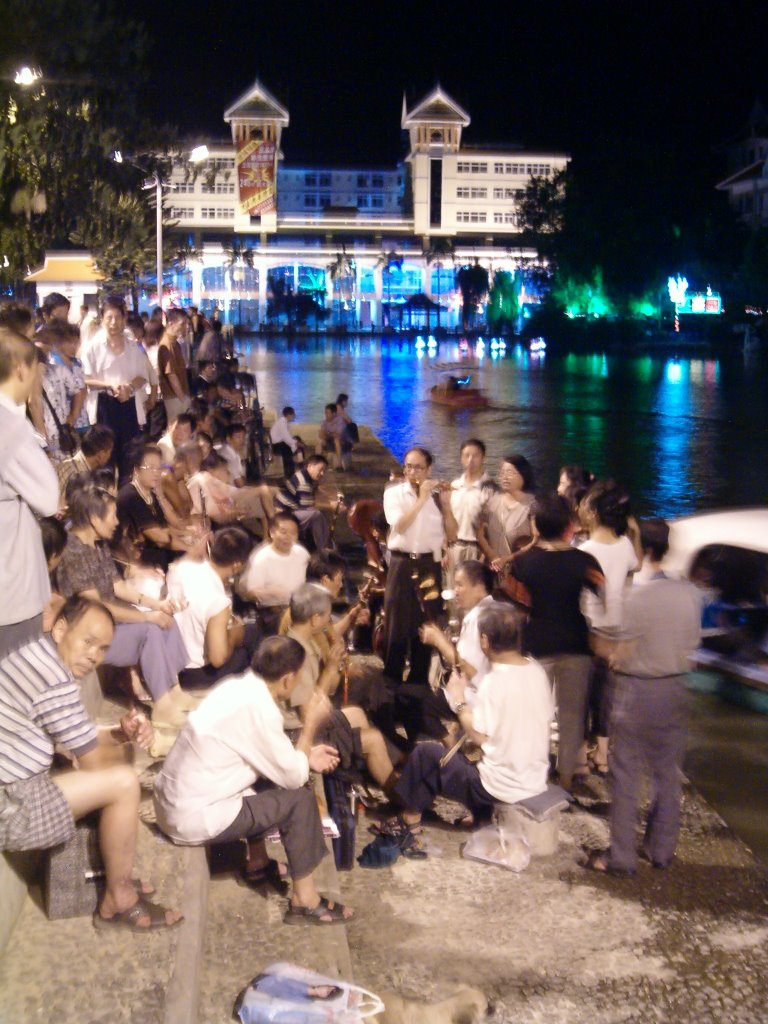
It was like everyone hibernates during the day, soaking up the sun's solar energy to be released as soon as it goes down. Vendors with headset mics barked verbal advertisements through loud, grainy speakers, beckoning potential buyers to witness the wonders of their products. One guy demonstrated a glass cutter while another played a tune on a stringed instrument he had for sale. A circle of about ten senior citizens danced around a tree, singing a sad song accompanied by twanging strings. At the edge of the lake, a crowd had gathered to watch another band of musicians--anchored by a severely nasal female singer--wail the night away. And this was just on one side of the lake.
Circling around, I passed lovers boarding paddleboats and an outdoor party where the drinks were flowing with the melody. A man sat on a makeshift stage playing his acoustic guitar and singing to entertain the crowd.
Even farther along, I happened upon a game called xiang qi, which is sometimes described as a Chinese version of chess. A small, old man with a long, gray fu-manchu crouched in the middle of a crowd, the gameboard directly in front of him. He looked straight ahead, deep in thought, mumbling to himself every now and then. The crowd that had gathered grew restless awaiting his next move, but he sat still, his bloodshot eyes glazing over. He was deep in either meditation or inebriation.
A man in the crowd yelled at the old man, trying to shake him from his stupor. Still no response. The old master's younger opponent waited respectfully for him to challenge his last move. This went on for about 10 minutes before I walked away. The whole experience had a strange vibe to it, like there was something spiritual attached to this particular game. As I moved back toward cell phone row, I wondered if the feeling is a result of my ignorance to the culture, or if some strange energy was afoot. Disregarding an internal urge to stay and watch the game unfold, I walked away and started toward the hotel. I had no cell phone, but I had gained invaluable cultural experience I could share with my teammates.

Hurdles

While eating spaghetti, our host (we'll call him Tim) told us about a lot of the projects he has undertaken in order to reach his people group, a rural minority group that adheres to an animistic form of Buddhism. A quick glimpse at the obstacles he faces shows how difficult missionary work is, and how much the missionary must rely on God for guidance with every new project.

For his organization, Tim is the highest authority responsible for reaching his people group. He casts the vision, drafts a master plan and hires necessary staff. He is the general, the head, the one in charge of his organization's efforts to bring these people into the kingdom. As such, he's aware of every project that seeks to either build relationships or sow the seed of the Gospel. Here are some of the things going on:

-Parables-Tim is currently developing culturally appropriate parables to use as training lessons for new believers that come from his people group's background. This taps into the overall intention of the parable: to explain deep truths with common language and imagery. Instead of the parable of the lost sheep, for instance, he might use the lost water buffalo. This doesn't water down the word; it makes it accessible to those who've never heard it before. Luckily, a believer from his people is helping him translate spiritual language into the people's vernacular.

-Translation-This people group has their own distinct writing system and about five different dialects of their language. The New Testament has been in print here for a long time, but the Old Testament has never been translated, much less read in the churches. Without a solid foundation of the Jewish people and their desire for a messiah, how will some of the New Testament passages (think Romans) even begin to make sense? Tim has a small team working on this at his office. They translate from Chinese into their language. They recently experienced a setback in production, when one of their team members, a girl in her late teens, died unexpectedly. Tim requests prayer in this endeavor.

-Laying foundations-Until the O.T. is completed, Tim must lay the foundation for the Gospel all by himself. He says that without a working knowledge of God's existence, man's sin, God's wrath and God's love, you can't even begin to talk about things like atonement and santification. He must start from the beginning, brick by brick building a view of God, a theology, from scratch, sometimes having to tear down strongholds that hinder construction. These people have been in bondage so long, he says, they have a lot of cobwebs to clear out of their thinking.

-Building Relationships-Surprisingly, this is the easy part and the reason we had traveled across the seas. Relationships are extremely important in China, and by giving of our time, we reflected well on Tim. His opportunities will hopefully multiply because we loved those kids and taught them a little bit of English.

Sunday, November 12, 2006

New Article

For those of you who are interested, I just had a two-page spread in The Red and Black newspaper in Athens. My article was about hiking trails in Athens, outdoor escapes inside the city limits. If you want to check it out, go to the link below and click on all the articles that say "Urban Hiker." My piece was one article with four parts, so they split it up on the Web site. You'll have to scroll down on the page to learn about the last three trails. Hopefully this will be the starting point for many more adventure pieces. Here goes:

URBAN HIKER