Wednesday morning was gloomy. Much like many other JH mornings, dark gray rainclouds shrouded the sky, and fog dulled the vibrant greens in the foothills of the surrounding Mekong valley. Tuesday weather was a bit brighter, and today's change in climate foreshadowed a dreary shift on the last day of camp.
During the party the night before, the mood was utter jubilation. The kids showered us with gifts, the most moving of which were not the bracelets and little pillows they made us, but the loving smiles they used to express their gratitude. With the coming of rain, though, everything turned upside-down. Smiles turned to frowns, joy gave way to anxiety, and the eagerness to learn faded into apathetic malaise. The kids' motivation was gone. They knew we were leaving, and we'd take with us the strange joy and love we'd brought to their lives.
We tried our best to stay cheerful whie we consoled the crying children, but our efforts inevitably resulted in more tears. Music class was a drag. The happy, cheesy songs lost their spunk when sung by a sobbing, slurring choir. We ended class early and used the time to say goodbyes. Afternoon activities were also cancelled so the kids could get an early start out to their villages.
The camp organizers wisely decided to get us on the bus quickly after the final whistle blew. We didn't need to prolong the inevitable. Once we were on the bus, the children gathered outside the windows, waving frantically as if they thought their waving could convince us to turn the bus around and stay with them for the entire school year.
Some of the students' flamboyant emotion can be attributed to their immaturity and the novelty of interacting with goofy foreigners. We were like the fun-loving uncle that gives kids a break from their strict parents. But I hope that some of the sadness they expressed was genuine, a natural and warranted response to aspects of Christ's love that they had never tasted before.
When students go home, how will they remember us? As jokesters, teachers, buddies, coaches, mentors, friends, or all of the above? Through all the activities, did we tap into their spiritual well and instill a hunger for more of the joy and peace we poured their lives? We may never know the answers to these questions, but we are sure that without even cracking a Bible, we accomplished the most important thing in missions: We were faithful to what God called us to do. And the results are in his big, capable hands.
Friday, December 22, 2006

Wednesday, December 20, 2006
Party Time
 It was Tuesday night, the eve of the last day of camp and the kids' last chance to show us their appreciation. When the final whistle blew Wednesday, most of the kids, all of whom were members of minority groups, would head back to their villages for a few days of rest before beginning one of two equally grueling activities: life on the farm or a semester of school.
Our team had eaten a quick dinner after classes adjourned at five, and we were back at school around 6:30, the 24 foreigners slowly being herded into an upstairs dance studio with an open floorplan and mirrors on the walls. We had held music classes there this week, trampling the green-carpeted floors with endless rounds of the "Hokey Pokey" and "Row, Row, Row Your Boat." Our normal set-up included rolling the slightly out-of-tune piano to the center of the room, and having the 50-or-so kids surround us as we taught them words and motions to accompany the songs.
But tonight, we were the ones being directed. Parents, teachers, and the entire mass of students (over 100) filled the room and watched with eager faces as we filed in. Many of the students (the girls) were dressed in their traditional minority garb: the Akha students their navy blue get-ups accented with colorful fringes and pom-poms, the Dai kids in vibrant silk dresses, heavy make-up and elaborate hairstyles. Others wore normal school clothing, t-shirts emblazoned with strange designs and slogans. My favorite? A yellow shirt with navy blue lettering that said "Nuke: Don't Do It" with a warhead and its fiery tail forming a Nike-esque swoosh beneath. The teachers lingered in front, waiting for our procession to stop and for us to take our seats.
Front and center in the makeshift auditorium, the students had set up a long row of stools topped with plates brimming with fresh pineapple and crabapples. Each stool was flanked by two or three unopened bottles of water, and the line of stools formed a barrier between the crowd and the open area that would serve as the stage. We sat behind the stools, our eyes wide at the fruity feast before us, our stomachs wondering if we could handle it so soon after dinner. The barred windows to the room were open, letting in a humid breeze and mixing the sallow remnants of sunlight with the bluish tint of the weak lightbulbs in the room. We were the guests of honor, and we couldn't wait to see what the program would hold.
The students' shy murmuring stopped as a male teacher, presumably one of the school's administrators, began to speak. He welcomed us to the celebration, stating clearly what we already knew: this program was to honor us for our generosity in coming to teach their students. He called for us to sit back and enjoy the program they had prepared for us.
The first few acts were minority songs and dances performed by both Akha and Dai students. The Dai students had been studying a dance their people had inherited from Thailand. The kids in the spotlight had looked so childish in their t-shirts and jeans, but they transformed into elegant performers when the music switched on. During my high-tension visit last year, there was no room for cultural experiences like this, and I was glad to finally be able to see some Dai traditions in action.
While the Dai dances were characterized by delicate, sweeping hand motions and steady, soothing rhythms, Akha dances were more masculine in nature, and their activities were more animated in general. One of them required crowd participation. Four pairs of parallel bamboo poles lay on the floor. There was an Akha student stationed at each side of each set. On the teacher's count, they would begin a sequence of banging these rods on the floor: open, close, open, close, open, open, close. The object was for a pair of foreigners to get through this gauntlet without getting their foot trapped by the bamboo poles, which slapped together whenever the teacher said "Close!" Luckily, I'd done something like this in elementary school P.E., so I was prepared. With Katy as my partner, I was able to hold my own even as the speed increased.
Other acts included: a magnificent harp player, a very entertaining rendition of a Britney Spears song, and a Dai dance at the end that had us in a circular conga line learning how to twirl our wrists in the air and bow gracefully. When the circle broke, the mass of people became a frenzy of gift-giving and camera flashes. The young girls had made friendship bracelets, and they began sliding them on the wrists of their favorite teachers. They had also crafted tiny pillows that hung on yarn necklaces, and they put them on the male teacher of choice. Someone told us later that in Dai tradition, to accept someone's bracelet was to accept their marriage proposal. So we joked that Stephen, who had a neck wreathed in colorful yarn and bracelets up to his armpits, would have an ample pool of prospective wives if he ever came back to China.
Sensing that the festivities were winding down, the students began disposing of the leftover pineapple, and not with a trash bag. Running around the room, giggling, they stuffed slices in our mouths until all the trays were empty and our stomachs were about to burst. The adults in our group called for us to gracefully peel ourselves from the kids. Tomorrow would be the last day of camp, and the students would need some rest after such an exciting night. They snapped pictures and fed us fruit until the very last of us made it to the door, where we retrieved our shoes from the huge pile that had accumulated there.
The mood on the way back to the hotel was exuberant. The kids had shown us through their actions how much they appreciated our work. But as the cliche goes, they taught us much more than we could've ever taught them. For a long time, their faces, smiling in gladhearted appreciation, will fuel my fire for missions. Although we couldn't directly give them the Gospel, they felt the love of Christ as we imparted it to them, and in that, we were faithful witnesses.
Monday, December 18, 2006
Powered Down

Within the span of a week, my cell phone battery broke, my computer's charger cord began acting up, I wrecked my car, and I lost my jacket and my watch. And I became an island. I could still use my computer and the internet, but my laptop lost its portability. So did my conversations. I had to borrow phones while at home to make arrangements for my car and to talk to Katy, who is three hours away. I rode the city bus to class for the first time, and I scrambled to find rides home from class and then to work. I couldn't keep up with time. I used to use my cell phone as a watch when my wrist was bare, but now that wasn't even an option. Many times, I was stranded for a few hours, waiting on someone to fulfill the items on their agenda before they got to mine.
It's amazing, and sad, the extent to which technology dictates my life, and the blessings I rarely think twice about. I rely on the cell phone rather than my brain to make plans, and I take for granted the convenience that owning my own car gives me. For my journalism classes, I often resort to the internet's fast-food format for information consumption rather than doing actual "shoe-leather" reporting. But with some of that gone, having to rely on other people, I faced a power outage in more than a literal sense. Without technology, I had little means to function in daily life.
John Mayer sings a song called "Something's Missing," in which he laments over the fact that he has everything he could want, but there's still a void in his life. In a live version of this song on his "Any Given Thursday" CD, he says, "How come everything I think I need always comes with batteries? What do you think it means?" Mired in this experience, I think I'm better prepared to answer this question.
Our reliance on batteries means that we live in a world that requires an increasing measure of technological savvy for our very survival. If communications networks were to be shut down indefinitely, most of us will lose all of our financial assets, which are tied up in electronic bank and stock databases. If we lose our telephones, we can no longer communicate. We've built sprawling cities that all but require us to have cars in order to function. Without them, there's just enough public transportation to get us where we're going, but not without a lot of walking and inconvenient downtime.
Being "powered down," stripped of all electronic amenities, has been trying, but it's helped me learn to appreciate things that electronics cannot provide: friendship and salvation. Friends took me to and from work. A friend provided me with a new cell phone for free. Friends are still offering to let me use their cars to take care of things. Many have expressed their regret that my life has become so "difficult." But through this time, God has been teaching me to put my faith in him rather than in things. If you can't remain faithful when wires get crossed, what will you do when real calamity comes?" he seems to be asking. He's helped me remember that true power comes from trusting in him for salvation and remaining thankful for what he has given me and what he's taken away. God is recharging my character.
It's amazing, and sad, the extent to which technology dictates my life, and the blessings I rarely think twice about. I rely on the cell phone rather than my brain to make plans, and I take for granted the convenience that owning my own car gives me. For my journalism classes, I often resort to the internet's fast-food format for information consumption rather than doing actual "shoe-leather" reporting. But with some of that gone, having to rely on other people, I faced a power outage in more than a literal sense. Without technology, I had little means to function in daily life.
John Mayer sings a song called "Something's Missing," in which he laments over the fact that he has everything he could want, but there's still a void in his life. In a live version of this song on his "Any Given Thursday" CD, he says, "How come everything I think I need always comes with batteries? What do you think it means?" Mired in this experience, I think I'm better prepared to answer this question.
Our reliance on batteries means that we live in a world that requires an increasing measure of technological savvy for our very survival. If communications networks were to be shut down indefinitely, most of us will lose all of our financial assets, which are tied up in electronic bank and stock databases. If we lose our telephones, we can no longer communicate. We've built sprawling cities that all but require us to have cars in order to function. Without them, there's just enough public transportation to get us where we're going, but not without a lot of walking and inconvenient downtime.
Being "powered down," stripped of all electronic amenities, has been trying, but it's helped me learn to appreciate things that electronics cannot provide: friendship and salvation. Friends took me to and from work. A friend provided me with a new cell phone for free. Friends are still offering to let me use their cars to take care of things. Many have expressed their regret that my life has become so "difficult." But through this time, God has been teaching me to put my faith in him rather than in things. If you can't remain faithful when wires get crossed, what will you do when real calamity comes?" he seems to be asking. He's helped me remember that true power comes from trusting in him for salvation and remaining thankful for what he has given me and what he's taken away. God is recharging my character.
Saturday, December 02, 2006
Holy Days

We've all heard the quote from St. Augustine: "Preach the Gospel; if necessary, use words." I agree with the Augustine's central idea, that there's value in a spirituality that shows itself more in works of love than in self-righteous ranting. Good works, though, should not be a subsitute for verbalizing the Gospel. Rather, they should serve as the seal of validity, the sign that the message we have received sets us apart from the world. (The apostles Paul and James offer some clarification on the issue. Paul: "Faith comes by hearing, and hearing by the word of God." James: "Faith without works is dead.")
Throughout the English camp, we had been keenly aware of the government restrictions that preclude any attempt to proselytize. From what I've heard (although I haven't had this objectively verified) it's illegal to preach the Gospel to any child under the age of 18. We had done our share of lifestyle evangelism. We smiled, hugged, played, and taught with authenticity and fervor, and it was unquestionable that our love for the children shined through. But without the Word, they might remain unclear about what motivated our selflessness.
On the second to last day of camp, we finally found a stealthful way to eliminate any ambiguity. The lesson for the day was holidays, and we started by asking some of the kids about their favorite Chinese holidays. Many mentioned Chinese New Year, the Dragonboat Festival and National Day, which commemorates the Communist takeover on October 1, 1949. We then found ways to relate these holidays to American holidays. For instance, we likened National Day to our Independence Day celebrations on the fourth of July, and we talked about how the Spring Festival is like Thanksgiving, a time to go home and visit family.
In this way, we were able to present Christmas and Easter in a natural flow of conversation as authentic American customs. We couldn't preach to them, but we could tell them what these holidays mean and why Americans, Christians in particular, feel they are so important to remember. With the help of a resident missionary, we translated the stories of the birth of Christ and his Resurrection. Citing miracles or parables would have been helpful, but we would leave that up to Tim and his later teams. This camp was called an "exposure" camp, and we were out to make sure the kids heard the essentials of the Gospel: Christ, God's son, came into the world to save those who had sinned against him (Christmas). To accomplish that, he died on a cross and rose again, displaying his authority over death and his ability to save sinners from it (Easter).
Throughout the English camp, we had been keenly aware of the government restrictions that preclude any attempt to proselytize. From what I've heard (although I haven't had this objectively verified) it's illegal to preach the Gospel to any child under the age of 18. We had done our share of lifestyle evangelism. We smiled, hugged, played, and taught with authenticity and fervor, and it was unquestionable that our love for the children shined through. But without the Word, they might remain unclear about what motivated our selflessness.
On the second to last day of camp, we finally found a stealthful way to eliminate any ambiguity. The lesson for the day was holidays, and we started by asking some of the kids about their favorite Chinese holidays. Many mentioned Chinese New Year, the Dragonboat Festival and National Day, which commemorates the Communist takeover on October 1, 1949. We then found ways to relate these holidays to American holidays. For instance, we likened National Day to our Independence Day celebrations on the fourth of July, and we talked about how the Spring Festival is like Thanksgiving, a time to go home and visit family.
In this way, we were able to present Christmas and Easter in a natural flow of conversation as authentic American customs. We couldn't preach to them, but we could tell them what these holidays mean and why Americans, Christians in particular, feel they are so important to remember. With the help of a resident missionary, we translated the stories of the birth of Christ and his Resurrection. Citing miracles or parables would have been helpful, but we would leave that up to Tim and his later teams. This camp was called an "exposure" camp, and we were out to make sure the kids heard the essentials of the Gospel: Christ, God's son, came into the world to save those who had sinned against him (Christmas). To accomplish that, he died on a cross and rose again, displaying his authority over death and his ability to save sinners from it (Easter).
Having to teach something to children makes you test whether you really believe it or not. Airing your beliefs is risky because you put yourself on the line. When you preach to crowds, you have nothing and no one to hide behind. If your audience counts you a fool, you have no recourse, no choice but to receive a barrage of ridicule while struggling to maintain your measure of faith, like a climber trying to keep a handhold as an avalanche comes down upon him.
Surprisingly, it's easier to keep a grip in China than it is in America, where an "enlightened" society doesn't welcome a Gospel that calls on faith in the unseen. As Christmas approaches, Christians must stand their ground against the culture that seeks to redefine the holiday. True, it's a time for gifts, food and family. But ultimately, it's a time to put ourselves on the line, to reaffirm that we believe in a story that is ridiculous by all human reasoning. God came down to a small nation in the form of a baby, in the womb of a virgin, to be born in a trough in a stable. Not so we could receive material wealth (let's not sell him short by worshipping perishable things), but to ransom us from the sin that holds us captive.
Are you willing to dedicate Christmas to Jesus and the spread of his Gospel? If so, you just might unwrap a greater measure of faith this holiday season.
Sunday, November 26, 2006
Leisurely Labor: A Sabbath Rest in China
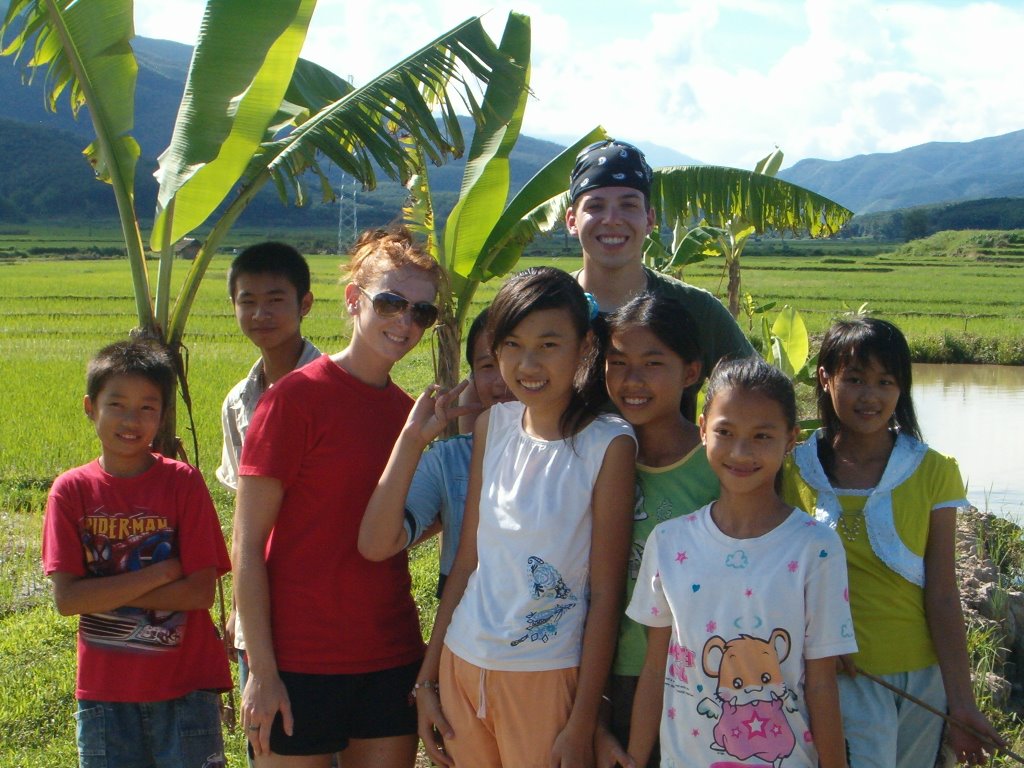
I use the previous post as a preface to this one, which will describe an unconventional but extremely relaxing and productive Sunday in China. We had no structured activities at the school, and we decided to take advantage of the day off to rest and regroup.
Our church service began at 10 a.m. in the office where Tim works. Elayne had asked me to put together a praise and worship set. With Michelle singing backup and Casey accompanying me on another acoustic guitar, I sang four songs, three of which were chosen with China in mind, particularly this region of China:
1. Nothing but the Blood of Jesus-I selected this song not only because I like it, but because I believe that the people here need to realize that salvation comes through no other name but Jesus and by no other means but his blood shed for them. The people here fear spirits, and only Jesus' blood can take that fear away.
2. God of Wonders-This song aptly relates the grandeur of a worldwide God. It helps us, the mission team, keep our minds focused on a God who is "beyond our galaxy" and "holy," which in its truest sense means, "set apart," or "different." God made us in his image, but he is not like us. He is far greater. This song also served as a sort of battle hymn for Steve and I on our trip to JH last year. We sang it as we walked to the bus stop on our first day hiking in the villages.
3. Ancient of Days-On our trip last year, we sang Ancient of Days in a remote village. A guy had come out of his hut playing a guitar with no top string. He lent me the guitar, and we praised God in the middle of a country that suppresses the Gospel.
Tim spoke about God's sovereignty and love, and how the two seemingly contradictory concepts are reconciled. It was a refreshing teaching time on a trip where we had been dishing out a lot of knowledge but taking in very little.
Lunch was even more refreshing. We took taxis to large hotel where were were served our best lunch yet. The banquet room was quiet, and for most of the time our massive group was the only one there. We occupied three circular, family-style dining tables. The place settings had milky white dishes, plastic chopsticks and small glass animals that served as chopstick stands, a far cry from the saucer-and-ricebowl meals we'd been served lately.
Although the hotel had Thai in its name, it served Chinese cuisine from the North, the kind most places in the U.S. serve. Naturally, this was more pleasing to our taste buds. Some of the girls ate more here than I'd seen them eat the entire rest of the week. In between bites, we made cheerful smalltalk and plans for the rest of the day. Some of the girls would go in search of pedicures, and some of the guys (and a few girls) would take a biking trip into the countryside to drink in the region's natural beauty. Others opted to swim at the hotel's pool and then head back to our hotel for an afternoon nap.
With all this talk of leisure, you might think that we forgot this was a mission trip. With only the information I've provided, you're justified in that assumption. But before you assume anything, I challenge you to start considering missions not as an event, but as a process, and one that in closed countries becomes painstakingly slow. Jesus often used farming analogies to talk about the kingdom. In order to grow a crop, you first have to plow the ground, shoveling any rocks out of the way to make room for the seed. Then you have to plant, water and tend the seed. Only after seasons of preparation and care do you see the harvest. In Corinthians, Paul shows that he's familiar with the concept: "Paul plants, Apollos waters, but God brings the harvest."
I say this not to make any excuse for laziness on the mission field; I don't endorse that at all. But I do want to emphasize that there are essential aspects of missions that don't involve standing in a pulpit or sharing the Bible with someone. And you don't have to avoid fun to get work done.
Our bike team was a perfect example of this. What started out as a leisurely ride evolved into a full-fledged prayer-walking (-riding?) expedition, on which we visited villages Brad and Bill had prayed in last year.
I can't tell you how much it meant to be back in this area, continuing the work we had begun a year ago. Even though I hadn't been to this exact spot, the villages on this side of the city were very similar to those where I had dropped VCDs and prayed before. And they house members of the same people group we'd been targeting, the same ornate Buddhist temples and decorative wells dedicated to gods that supposedly provide them with the rain that fills the puddles in their rice paddies, which in turn fill their stomachs with food. Exactly what God had in mind, I don't know, but I'm glad that God chose to use at this time, in this part of his grand redemptive plan for this people.
Three hours and 10-15 miles later we arrived back at the hotel, ready for warm showers and hot dinner. After dinner, Katy and I went to a massage parlor for a miniature date to complete the relaxing evening.
Our church service began at 10 a.m. in the office where Tim works. Elayne had asked me to put together a praise and worship set. With Michelle singing backup and Casey accompanying me on another acoustic guitar, I sang four songs, three of which were chosen with China in mind, particularly this region of China:
1. Nothing but the Blood of Jesus-I selected this song not only because I like it, but because I believe that the people here need to realize that salvation comes through no other name but Jesus and by no other means but his blood shed for them. The people here fear spirits, and only Jesus' blood can take that fear away.
2. God of Wonders-This song aptly relates the grandeur of a worldwide God. It helps us, the mission team, keep our minds focused on a God who is "beyond our galaxy" and "holy," which in its truest sense means, "set apart," or "different." God made us in his image, but he is not like us. He is far greater. This song also served as a sort of battle hymn for Steve and I on our trip to JH last year. We sang it as we walked to the bus stop on our first day hiking in the villages.
3. Ancient of Days-On our trip last year, we sang Ancient of Days in a remote village. A guy had come out of his hut playing a guitar with no top string. He lent me the guitar, and we praised God in the middle of a country that suppresses the Gospel.
Tim spoke about God's sovereignty and love, and how the two seemingly contradictory concepts are reconciled. It was a refreshing teaching time on a trip where we had been dishing out a lot of knowledge but taking in very little.
Lunch was even more refreshing. We took taxis to large hotel where were were served our best lunch yet. The banquet room was quiet, and for most of the time our massive group was the only one there. We occupied three circular, family-style dining tables. The place settings had milky white dishes, plastic chopsticks and small glass animals that served as chopstick stands, a far cry from the saucer-and-ricebowl meals we'd been served lately.
Although the hotel had Thai in its name, it served Chinese cuisine from the North, the kind most places in the U.S. serve. Naturally, this was more pleasing to our taste buds. Some of the girls ate more here than I'd seen them eat the entire rest of the week. In between bites, we made cheerful smalltalk and plans for the rest of the day. Some of the girls would go in search of pedicures, and some of the guys (and a few girls) would take a biking trip into the countryside to drink in the region's natural beauty. Others opted to swim at the hotel's pool and then head back to our hotel for an afternoon nap.
With all this talk of leisure, you might think that we forgot this was a mission trip. With only the information I've provided, you're justified in that assumption. But before you assume anything, I challenge you to start considering missions not as an event, but as a process, and one that in closed countries becomes painstakingly slow. Jesus often used farming analogies to talk about the kingdom. In order to grow a crop, you first have to plow the ground, shoveling any rocks out of the way to make room for the seed. Then you have to plant, water and tend the seed. Only after seasons of preparation and care do you see the harvest. In Corinthians, Paul shows that he's familiar with the concept: "Paul plants, Apollos waters, but God brings the harvest."
I say this not to make any excuse for laziness on the mission field; I don't endorse that at all. But I do want to emphasize that there are essential aspects of missions that don't involve standing in a pulpit or sharing the Bible with someone. And you don't have to avoid fun to get work done.
Our bike team was a perfect example of this. What started out as a leisurely ride evolved into a full-fledged prayer-walking (-riding?) expedition, on which we visited villages Brad and Bill had prayed in last year.
I can't tell you how much it meant to be back in this area, continuing the work we had begun a year ago. Even though I hadn't been to this exact spot, the villages on this side of the city were very similar to those where I had dropped VCDs and prayed before. And they house members of the same people group we'd been targeting, the same ornate Buddhist temples and decorative wells dedicated to gods that supposedly provide them with the rain that fills the puddles in their rice paddies, which in turn fill their stomachs with food. Exactly what God had in mind, I don't know, but I'm glad that God chose to use at this time, in this part of his grand redemptive plan for this people.
Three hours and 10-15 miles later we arrived back at the hotel, ready for warm showers and hot dinner. After dinner, Katy and I went to a massage parlor for a miniature date to complete the relaxing evening.
Subscribe to:
Posts (Atom)